April 04, 2012 (LBO) - Sri Lankan shares closed slightly lower Wednesday with retail investors active and turnover boosted by several crossings and while the rupee gained ground against the dollar, brokers and dealers said.
The rupee closed around 125.40/50 to the US dollar dealers said after opening 126.00/10 levels.
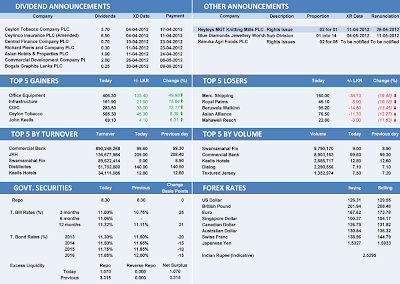
The main All Share Price Index fell 0.15 percent (8.34 points) to 5408.31, while the more liquid Milanka index fell 0.09 percent (4.62) to close at 4881.55.
Turnover was 1.13 billion rupees, according to stock exchange provisional figures.
Swarnamahal Financial Services was actively traded and closed at 8.60 rupees, down 40 cents, having touched a high of 9.10 rupees.
Ceylon Tobacco Company closed at 597 rupees, up 11.70 rupees while Chevron Lubricants ended on 184 rupees, down 80 cents. Both counters reached 52 week highs in trade Wednesday.
Central Finance closed flat at 170 rupees, and was the largest contributor to the day’s turnover.
Crossings or off the floor transactions accounted for nearly 39 percent of turnover.
A total 13.7 million shares in Fortress Resorts changed hands at 18 rupees a piece. The share closed at 15.80 rupees, down 70 cents.
Hayleys recorded a crossing of 370,000 shares at 370 rupees each, while 275,000 shares of John Keells Holdings crossed at 208 rupees a share, closing flat at 209 rupees.
Commercial Bank ended the day on 99.50 rupees, down 10 cents while HNB closed at 152.50 rupees, up 2.30 rupees.
Telco Dialog closed at 7 rupees, with no change from its previous day’s close, and SLT at 44.70 rupees, down 10 cents.
Environmental Resources Investments closed at 15.80 rupees, down 60 cents, HVA Foods at 13.20 rupees, down 90 cents, Regnis Lanka at 124.90 rupees, down 2.90 rupees, and Softlogic Capital at 8 rupees, down 30 cents.
source - www.lbo.lk
Wednesday, April 4, 2012

Rupee up; Bourse sees Rs. 374 m foreign inflow
The rupee gained 1.7 per cent on Tuesday as exporters sold dollars after the International Monetary Fund approved thedisbursement of a long-delayed loan tranche of $ 426.8 million to the Government. The rupee strengthened to 126.00/126.30 a dollar from Monday’s close of 128.25/128.30.
Dealers said the currency strengthened to 125.60 some importer dollar demand curbed the surge. The currency has risen 4.3 per cent since hitting a record low of 131.60 on 19 March.
However, it has fallen 9.4 per cent since the Central Bank stopped defending it on 9 February.
The IMF on Tuesday approved the eighth tranche of Sri Lanka’s $ 2.6 billion loan with waivers after the country adopted a flexible exchange rate and took measures to avert a balance-of-payments crisis.
On Tuesday, the Central Bank said the country’s reserves had increased to $ 6.1 billion after the IMF approval and were enough to cover 3.6 months imports, which should help improve confidence that the monetary authorities could handle a sudden flight of foreign capital.
The stock market edged up 0.3 per cent or 17.95 points to 5,416.65 on Tuesday as the IMF announcement gave some confidence to retail investors while block deals in Commercial Bank of Ceylon PLC, which edged up 0.30 per cent, pushed the turnover.
Analysts said investors still remained cautious of rising interest rates, the direction of rupee and an expected fall in corporate profits.
The day’s turnover was Rs. 1.53 billion ($ 11.93 million), slightly above this year’s daily average of 1.37 billion. Foreign investors were net buyers of 374 million.
The Colombo Bourse is one of the worst performers this year among Asian markets, with a 10.83 per cent loss.
source - www.ft.lk
Dealers said the currency strengthened to 125.60 some importer dollar demand curbed the surge. The currency has risen 4.3 per cent since hitting a record low of 131.60 on 19 March.
However, it has fallen 9.4 per cent since the Central Bank stopped defending it on 9 February.
The IMF on Tuesday approved the eighth tranche of Sri Lanka’s $ 2.6 billion loan with waivers after the country adopted a flexible exchange rate and took measures to avert a balance-of-payments crisis.
On Tuesday, the Central Bank said the country’s reserves had increased to $ 6.1 billion after the IMF approval and were enough to cover 3.6 months imports, which should help improve confidence that the monetary authorities could handle a sudden flight of foreign capital.
The stock market edged up 0.3 per cent or 17.95 points to 5,416.65 on Tuesday as the IMF announcement gave some confidence to retail investors while block deals in Commercial Bank of Ceylon PLC, which edged up 0.30 per cent, pushed the turnover.
Analysts said investors still remained cautious of rising interest rates, the direction of rupee and an expected fall in corporate profits.
The day’s turnover was Rs. 1.53 billion ($ 11.93 million), slightly above this year’s daily average of 1.37 billion. Foreign investors were net buyers of 374 million.
The Colombo Bourse is one of the worst performers this year among Asian markets, with a 10.83 per cent loss.
source - www.ft.lk

Big seller of Com Bank disposes further 8.5 million shares
* Bourse edges down but turnover tops billion
* SEC re-imposes restrictions on warrants
Six crossings yesterday in the voting shares of Commercial Bank involving a total of 8.5 million shares at a price of Rs. 100 per share helped boost turnover on the Colombo bourse to Rs. 1.53 billion, up from the previous day’s Rs. 694.6 million, though both indices were marginally down - the All Share by 13.33 points (0.25%) and the Milanka by 2.78 points (0.06%) with 65 gainers trailing 127 losers.
The Com Bank crossings contributed Rs. 850 million to the day’s turnover, and with a crossing of nearly 0.4 million JKH at Rs. 210 generating a turnover of Rs. 83.3 million, yielded most of the day’s business volume.
Brokers said that the Japanese bank which acquired the Com Bank stake sold by the DFCC Bank on a regulatory direction was the seller. This investor who is estimated to have some 1.5 million Com Bank shares left has been selling at the Rs. 100 price recently. There was no word on the buyer/s.
Apart from the Com Bank crossings, over 0.3 million shares of this counter were done on the trading floor, closing 70 cents up at Rs. 100.
Swarnamahal Financial Services was the second biggest business generator yesterday with retail activity evident in the counter where 9.8 million shares, were traded closing 10 cents up at Rs. 9 contributing Rs. 89.6 million to turnover.
JKH also saw nearly 0.3 million traded on the floor closing 60 cents up at Rs. 209 contributing Rs. 53.3 million to turnover.
Cargills with 0.1 million shares transacted closed Rs. 3.70 up at Rs. 175 while Keells Hotels, with a block of 1.9 million shares crossed at 12.70 and nearly 0.8 million done on the floor, closed 10 cents up also at 12.70.
The SEC announced re-imposition of restrictions on extending trading periods on warrants saying this had been done after considering the impact on investors in the secondary market due to actions taken by some listed companies relating to warrants.
Under the listing rules of the CSE, a listed company is required to announce to the market terms and conditions of warrants at the time of their issue, the SEC announcement said.
"The terms and tenure of a warrant is determined by the risk attached to such financial instrument," it explained. "Thus the warrant holders should not be allowed to transfer the risk attached to the terms of such warrants after the risk event has occurred, by extending the cut-off date."
source - www.island.lk
* SEC re-imposes restrictions on warrants
Six crossings yesterday in the voting shares of Commercial Bank involving a total of 8.5 million shares at a price of Rs. 100 per share helped boost turnover on the Colombo bourse to Rs. 1.53 billion, up from the previous day’s Rs. 694.6 million, though both indices were marginally down - the All Share by 13.33 points (0.25%) and the Milanka by 2.78 points (0.06%) with 65 gainers trailing 127 losers.
The Com Bank crossings contributed Rs. 850 million to the day’s turnover, and with a crossing of nearly 0.4 million JKH at Rs. 210 generating a turnover of Rs. 83.3 million, yielded most of the day’s business volume.
Brokers said that the Japanese bank which acquired the Com Bank stake sold by the DFCC Bank on a regulatory direction was the seller. This investor who is estimated to have some 1.5 million Com Bank shares left has been selling at the Rs. 100 price recently. There was no word on the buyer/s.
Apart from the Com Bank crossings, over 0.3 million shares of this counter were done on the trading floor, closing 70 cents up at Rs. 100.
Swarnamahal Financial Services was the second biggest business generator yesterday with retail activity evident in the counter where 9.8 million shares, were traded closing 10 cents up at Rs. 9 contributing Rs. 89.6 million to turnover.
JKH also saw nearly 0.3 million traded on the floor closing 60 cents up at Rs. 209 contributing Rs. 53.3 million to turnover.
Cargills with 0.1 million shares transacted closed Rs. 3.70 up at Rs. 175 while Keells Hotels, with a block of 1.9 million shares crossed at 12.70 and nearly 0.8 million done on the floor, closed 10 cents up also at 12.70.
The SEC announced re-imposition of restrictions on extending trading periods on warrants saying this had been done after considering the impact on investors in the secondary market due to actions taken by some listed companies relating to warrants.
Under the listing rules of the CSE, a listed company is required to announce to the market terms and conditions of warrants at the time of their issue, the SEC announcement said.
"The terms and tenure of a warrant is determined by the risk attached to such financial instrument," it explained. "Thus the warrant holders should not be allowed to transfer the risk attached to the terms of such warrants after the risk event has occurred, by extending the cut-off date."
source - www.island.lk
Tuesday, April 3, 2012
Sri Lanka to Receive $426.8 Million After IMF Review

The International Monetary Fund’s board of directors released $426.8 million to Sri Lanka after reviewing the country’s implementation of economic policies attached to a $2.56 billion loan.
Sri Lanka in February raised interest rates for the first time since 2007, let its currency weaken to a record low and increased fuel prices. The moves aim to curb imports such as oil, contain a trade gap and stem a decline in foreign-exchange reserves, as officials grapple with resurgent domestic demand following the end of the island’s civil war in 2009.
“The adjustment measures implemented by the authorities have placed the economy on a more sustainable trajectory,” IMF Deputy Managing Director Zhu Min, who presided over the board meeting, said in a press release.
“However, it will take time for the new monetary and exchange rate regime to become fully established, and the authorities will need to stand ready to adjust policies further to stabilize external reserves, especially if the global environment becomes less favorable,” he said.
The board of the Washington-based IMF also agreed to extend the period of the loan to July 23 to allow one more review of policies, it said in an e-mailed statement.
“The release of funds and IMF approval will be positive for stability, investment and the markets,” Sanjeewa Fernando, an analyst at CT Smith Stockbrokers Pvt. in the Sri Lankan capital Colombo, said before the IMF announcement. “It will help support the rupee.”
Sri Lanka’s foreign reserves fell about 26 percent to $5.96 billion by December from $8.1 billion in July as the trade gap swelled. The decline prompted Standard & Poor’s to lower the island’s sovereign rating outlook to stable from positive at the end of February. Fitch Ratings has said the depleted reserves have increased balance-of-payments risks.
source - www.bloomberg.com

$ 400 m IMF lifeline for struggling Sri Lanka
Sri Lanka is to get a $ 400 million lifeline following what is anticipated as a favourable decision on the part of the International Monetary Fund (IMF).
The IMF Board was scheduled to meet Monday evening Washington Time, and its Resident Representative Koshy Mathai is scheduled to hold a briefing today in Colombo at 2.00 p.m.
Speculation was rife within official circles and financial markets that Sri Lanka will receive approximately $ 400 million from the remaining $ 800 million under the Stand By Arrangement (SBA).
The balance funds are expected after a fresh review which will be final before the program ends. The previous timeline for the end was end-May 2012.
Analysts said that in recent months, and especially during the past few weeks, the Government collectively has been burning the mid-night oil to improve its fiscal and monetary management in order to qualify for IMF assistance.
With reserves under tremendous pressure despite Government assurances, the Opposition and other analysts have insisted that a mini-IMF bailout was critical at this juncture.
Under the July 2009-approved $ 2.6 billion SBA, there had been eight reviews and seven tranches released to the tune of $ 1.7 billion. The last tranche of $ 218 million was released exactly a year ago. When that boost came in Sri Lanka’s reserves were $ 7.2 billion which was enough to meet 6.3 months of imports, though in January this year the strength had diminished to buy only three to four months of imports.
However from-mid last year the economic management of President Mahinda Rajapaksa Government had been off-track due to a multitude of reasons which led to IMF funds being withheld. Undeterred Central Bank remained upbeat it could steer the reserves and the economy from hitting a near-crisis level. The deterioration of the reserves and its fallout on the economy, exchange rate, interest rate and inflation saw sweeping measures from November 2011 onwards with the presentation of 2012 Budget by President Rajapaksa.
The expectation of fresh release of funds from IMF comes after the Government originally implied it could do well without it. As recently as a fortnight ago Treasury Secretary Dr. P.B. Jayasundera told media that IMF support wasn’t a concern and if comes through it will be a bonus.
He also assured that serious loss of reserves has been arrested. However on Saturday, Treasury effected what some described as a mini-Budget raising taxes on high-growth import of vehicles.
Reason cited was to reduce imports, save fuel and ease traffic on the roads. However a degree of desperation to boost revenue was evident from that move as well as hiking taxes on liquor and tobacco.
When the fuel prices were revised upwards in an unprecedented manner in January, the Government was confident that the demand for vehicle imports will reduce. The Saturday’s revision in taxes proved that the Government wasn’t fully convinced with its own stand. These moves were in addition to a near 15% depreciation of the rupee, which also makes imports more expensive as well as curbs on bank lending.
It was in this context that analysts described Saturday’s mini-Budget as sheer desperate move by the Government whilst the Opposition said it was to qualify for IMF assistance, a view which the Treasury denied subsequently.
IMF money will stabilise rupee – Basil
Economic Development Minister Basil Rajapaksa yesterday had said the rupee will stabilise once the IMF money comes in to the island nation’s $59 billion economy.
“Some people are holding dollar conversions and I think they will bring them when they see the stability. The stability level will be a price suitable for importers, exporters and Government,” Rajapaksa told reporters, without elaborating, the Reuters reported.
The rupee edged down on Monday on last-minute importer dollar demand for the upcoming new year season, and as traders shrugged off an expected $400 million inflow from the International Monetary Fund’s latest release of a loan tranche.
The rupee weakened to 128.25/128.30 a dollar from Friday’s close of 128.10/128.30, in light trade with low dollar sales by exporters ahead of the April festival season. The currency has risen 2.6% since it hit a record low of 131.60 on March 19.
But it has fallen 10.9% since the central bank stopped defending it on Feb. 9.
The IMF on Friday said it will consider making a $400 million disbursement on Monday and the final $400 million tranche of a $2.6 billion loan a few months later.
Analysts expect depreciation pressure to remain in the medium to longer term until the country sees stronger export revenues.
The central bank on Friday said that more than $500 million in investment is expected over the next few weeks, after the country received $164.2 million of inflows into the stock market and $400 million into Government securities in the first quarter.
A hike in motor vehicle import taxes by the Government pulled the stock market 0.4% or 21.50 points down to 5,398.70 to a one-week low with the motor sector index falling 8.11%.
The new tax policy also pulled down shares of India’s Bajaj Auto, which account for 10% of overall sales in Sri Lanka, by 1.4%.
The day’s turnover was 694.6 million Sri Lanka rupees ($5.42 million), well below this year’s daily average of 1.35 billion. Foreign investors were net buyers of 34.4 million.
The Colombo bourse is one of the worst performers this year among Asian markets, with a 11.1% loss.
source - www.ft.lk


China, India, S’pore looking for long term options in Lanka
*Increasing trend
*HSBC bullish on Lanka, says Asia Pacific Head of Corporate
*Too early for corporates to raise capital overseas, but economy moving in right direction
*Investors not overly concerned about policy reversals, expropriation law
Global banking giant HSBC is bullish on Sri Lanka with investors in China, India and Singapore increasingly approaching the bank for information on long term investment opportunities in the country.
"China, India and Singapore are increasingly interested in investing in a broad range of sectors and these investments are likely to materialise over the next 12 to 18 months," HSBC Asia Pacific Regional Head of Corporate David Morton told The Island Financial Review.
Morton was in the country for a brief visit, meeting clients and senior officials of HSBC Sri Lanka. He also took the time to visit tourist attractions down South, such as the wildlife sanctuary in Yala, ‘contributing to the economy as a tourist’.
"Sri Lanka has a very bright future," he told this newspaper in a brief interview on his first day here.
"There is a group of emerging tigers in the region and Sri Lanka is in that category. Sri Lanka has a well educated population. Intellectual capital is the first requisite of development. For example take the Singapore model, it has very little resources but the sheer drive of its people lifted the country to where it is today," he said.
Morton also commended the level of English proficiency in the country.
"It is the language of business and it is easier to start up a firm, such as a BPO or call centre, because you can attract the right talent here in Sri Lanka," he said.
Recent policy reversals and a controversial expropriation law passed in parliament last year drew some negative comments from sovereign rating agencies, investors and fund managers, but Morton said the type of investors dealing with the bank were not overly concerned based on the longer terms prospects of the country.
"The investors we deal with think of making long term investments, for 10, 20 and 30, years so they look at these issues in that perspective and through economic cycles. We are focused on attracting long term equity into the country. You do not want to see hot capital flow into the country, where these short term investors flip their capital, make huge profits and then withdraw their investments. We have seen this happen in other economies. This is not what Sri Lanka needs. The country needs patient capital and it will get it if it continues to show stability, have good people with strong work ethics and benign economic circumstances," he said.
Morton says the country’s corporate sector is probably not in a position to raise funds from global capital markets just yet, but the sector has a very bright future.
"Sri Lanka has a long established group of corporates which navigated through very difficult times and still grew. For them, the future is brighter than ever before because they are profitable and can raise capital. However, the economy is not at a stage where the corporate sector can raise funds from global capital markets.
"The government has started issuing sovereign bonds which is a first step toward creating a yield curve on which corporate debt can be priced. With time, the government would be able to issue bonds with longer and longer tenures, and this will help establish a yield curve for corporates to price their debt. This is where HSBC comes in because our differentiation is the global network.
"We can take local financial institutions to the global capital markets, which is the next step, and they then can use the benefit of that capital funding at lower rates, which reduces the costs to the economy, to lend at lower rates to domestic businesses. Then the next step is for the corporate sector to tackle global markets.
All this will take time and I believe Sri Lanka is on the right path.
"The entrepreneurial spirit is alive and well, and I have seen some well structured corporate transactions HSBC has supported over the past few years. We have assisted some infrastructure projects and I am quite impressed so far," Morton said.
"HSBC has been a longstanding supporter of the Sri Lankan textiles industry and its expansion onto the regional stage. We have been providing trade finance solutions to the industry for over 25 years and are now taking the best companies offshore to assist expansion," he said.
Morton said Sri Lanka was an emerging jewel in the international leisure sector with many magazines highlighting the beauty of the country. He said the leisure sector would provide a lot of employment opportunities, but said Sri Lanka should maintain the natural beauty of the country, which would be an ‘invaluable source of sustainable revenue as long as it was not spoiled’.
Commenting on the emergence of a balance of payments crisis, Morton believes the Central Bank acted early.
"Crisis is a too harsh word to use. When credit growth is excessive you know you are heading for a problem. I believe the Central Bank acted quite early in the cycle and adopted very sensible policies which put it ahead of the problem, this is what central banks are supposed to do after all," he said.
According to the Central Bank, Sri Lanka’s economy is expected to grow 7.2 percent this year, downgraded from an earlier 8 percent forecast.
The trade deficit ballooned 99.6 percent last year to US$ 9,743.2 billion while private sector credit growth was higher than what the Central Bank predicted it would be at 36.6 percent.
Around US$ 3 billion was sold from official reserves to keep the exchange rate stable from June 2011 until the Central Bank stopped intervening in the foreign exchange market early February. During this time, Rs. 300 billion was pumped into the banking system as the dollar sales were draining rupee liquidity already hit my high credit growth.
Economists had been warning of a balance of payments crisis during the latter half of 2011. The IMF had withheld the disbursement of a US$ 400 million tranche under US$ 2.6 standby facility programme as it was not happy with the country’s exchange rate policy.
Last February, the Central Bank gave up its hold on the exchange rate, allowing the rupee to float against the dollar, which saw the currency reach record lows. Credit growth was restricted to 18 percent and policy interest rates were increased by 50 basis points.
The government announced increases to domestic fuel prices and electricity tariff. Duties on vehicle imports, cigarettes and tobacco were increased to curb imports.
source - www.island.lk
*HSBC bullish on Lanka, says Asia Pacific Head of Corporate
*Too early for corporates to raise capital overseas, but economy moving in right direction
*Investors not overly concerned about policy reversals, expropriation law
Global banking giant HSBC is bullish on Sri Lanka with investors in China, India and Singapore increasingly approaching the bank for information on long term investment opportunities in the country.
"China, India and Singapore are increasingly interested in investing in a broad range of sectors and these investments are likely to materialise over the next 12 to 18 months," HSBC Asia Pacific Regional Head of Corporate David Morton told The Island Financial Review.
Morton was in the country for a brief visit, meeting clients and senior officials of HSBC Sri Lanka. He also took the time to visit tourist attractions down South, such as the wildlife sanctuary in Yala, ‘contributing to the economy as a tourist’.
"Sri Lanka has a very bright future," he told this newspaper in a brief interview on his first day here.
"There is a group of emerging tigers in the region and Sri Lanka is in that category. Sri Lanka has a well educated population. Intellectual capital is the first requisite of development. For example take the Singapore model, it has very little resources but the sheer drive of its people lifted the country to where it is today," he said.
Morton also commended the level of English proficiency in the country.
"It is the language of business and it is easier to start up a firm, such as a BPO or call centre, because you can attract the right talent here in Sri Lanka," he said.
Recent policy reversals and a controversial expropriation law passed in parliament last year drew some negative comments from sovereign rating agencies, investors and fund managers, but Morton said the type of investors dealing with the bank were not overly concerned based on the longer terms prospects of the country.
"The investors we deal with think of making long term investments, for 10, 20 and 30, years so they look at these issues in that perspective and through economic cycles. We are focused on attracting long term equity into the country. You do not want to see hot capital flow into the country, where these short term investors flip their capital, make huge profits and then withdraw their investments. We have seen this happen in other economies. This is not what Sri Lanka needs. The country needs patient capital and it will get it if it continues to show stability, have good people with strong work ethics and benign economic circumstances," he said.
Morton says the country’s corporate sector is probably not in a position to raise funds from global capital markets just yet, but the sector has a very bright future.
"Sri Lanka has a long established group of corporates which navigated through very difficult times and still grew. For them, the future is brighter than ever before because they are profitable and can raise capital. However, the economy is not at a stage where the corporate sector can raise funds from global capital markets.
"The government has started issuing sovereign bonds which is a first step toward creating a yield curve on which corporate debt can be priced. With time, the government would be able to issue bonds with longer and longer tenures, and this will help establish a yield curve for corporates to price their debt. This is where HSBC comes in because our differentiation is the global network.
"We can take local financial institutions to the global capital markets, which is the next step, and they then can use the benefit of that capital funding at lower rates, which reduces the costs to the economy, to lend at lower rates to domestic businesses. Then the next step is for the corporate sector to tackle global markets.
All this will take time and I believe Sri Lanka is on the right path.
"The entrepreneurial spirit is alive and well, and I have seen some well structured corporate transactions HSBC has supported over the past few years. We have assisted some infrastructure projects and I am quite impressed so far," Morton said.
"HSBC has been a longstanding supporter of the Sri Lankan textiles industry and its expansion onto the regional stage. We have been providing trade finance solutions to the industry for over 25 years and are now taking the best companies offshore to assist expansion," he said.
Morton said Sri Lanka was an emerging jewel in the international leisure sector with many magazines highlighting the beauty of the country. He said the leisure sector would provide a lot of employment opportunities, but said Sri Lanka should maintain the natural beauty of the country, which would be an ‘invaluable source of sustainable revenue as long as it was not spoiled’.
Commenting on the emergence of a balance of payments crisis, Morton believes the Central Bank acted early.
"Crisis is a too harsh word to use. When credit growth is excessive you know you are heading for a problem. I believe the Central Bank acted quite early in the cycle and adopted very sensible policies which put it ahead of the problem, this is what central banks are supposed to do after all," he said.
According to the Central Bank, Sri Lanka’s economy is expected to grow 7.2 percent this year, downgraded from an earlier 8 percent forecast.
The trade deficit ballooned 99.6 percent last year to US$ 9,743.2 billion while private sector credit growth was higher than what the Central Bank predicted it would be at 36.6 percent.
Around US$ 3 billion was sold from official reserves to keep the exchange rate stable from June 2011 until the Central Bank stopped intervening in the foreign exchange market early February. During this time, Rs. 300 billion was pumped into the banking system as the dollar sales were draining rupee liquidity already hit my high credit growth.
Economists had been warning of a balance of payments crisis during the latter half of 2011. The IMF had withheld the disbursement of a US$ 400 million tranche under US$ 2.6 standby facility programme as it was not happy with the country’s exchange rate policy.
Last February, the Central Bank gave up its hold on the exchange rate, allowing the rupee to float against the dollar, which saw the currency reach record lows. Credit growth was restricted to 18 percent and policy interest rates were increased by 50 basis points.
The government announced increases to domestic fuel prices and electricity tariff. Duties on vehicle imports, cigarettes and tobacco were increased to curb imports.
source - www.island.lk
EPF buys 5% more of Piramal Glass for Rs. 280.5 m; with 10% stake now biggest local shareholder
Employees Provident Fund (EPF) yesterday bought a 5% stake in Piramal Glass Plc for Rs. 280.5 million increasing its overall holding to near 10% thereby becoming the single largest local shareholder.
Prior to yesterday’s purchase, EPF held 4.11% stake as at end 2011, up from 1.94% in September.
The block of 5% stake amounted to 45.3 million shares done at Rs. 6.20 each, 20 cents above Friday’s close. The stock price of Piramal ended 10 cents down with a total of 45.5 million shares traded. Its net asset per share is Rs. 3.20.
The seller was high net worth individual R.F.T. Perera, who in end September held 6% stake or 57 million shares.
EPF’s buying into Indian-controlled Piramal, was part of an overall Rs. 325 million investment in to listed securities yesterday.
Among other shares it bought were Rs. 16 million worth of Dipped Products and Rs. 9 million worth of Sampath Bank shares.
In the nine months of 2011/12 financial year, Piramal Glass made a Rs. 588.6 million profit, up from Rs. 400 million a year earlier. It also managed to improve third quarter profit to Rs. 205 million from Rs. 190 million.
However with the recent increase in fuel and electricity prices, analysts said the Company was worst hit. In that context, EPF’s buying to Piramal had raised a few eyebrows.
source - www.ft.lk
Prior to yesterday’s purchase, EPF held 4.11% stake as at end 2011, up from 1.94% in September.
The block of 5% stake amounted to 45.3 million shares done at Rs. 6.20 each, 20 cents above Friday’s close. The stock price of Piramal ended 10 cents down with a total of 45.5 million shares traded. Its net asset per share is Rs. 3.20.
The seller was high net worth individual R.F.T. Perera, who in end September held 6% stake or 57 million shares.
EPF’s buying into Indian-controlled Piramal, was part of an overall Rs. 325 million investment in to listed securities yesterday.
Among other shares it bought were Rs. 16 million worth of Dipped Products and Rs. 9 million worth of Sampath Bank shares.
In the nine months of 2011/12 financial year, Piramal Glass made a Rs. 588.6 million profit, up from Rs. 400 million a year earlier. It also managed to improve third quarter profit to Rs. 205 million from Rs. 190 million.
However with the recent increase in fuel and electricity prices, analysts said the Company was worst hit. In that context, EPF’s buying to Piramal had raised a few eyebrows.
source - www.ft.lk
Monday, April 2, 2012
Ajita new Chairman at Sathosa Motors, Sumal MD
Business leader Ajita de Zoysa has been appointed as the new Chairman of Sathosa Motor Plc., whilst its former Chairman and now controlling shareholder Sumal Perera has become the Managing Director.
The change, effective from 2 April, is following the resignation of the nominees who represented the interests of ITOCHU Corporation of Japan.
Itochu sold out to Access Engineering Ltd., last month. Sumal also resigned as their representative after which he was appointed Managing Director.
Executive Director Thilak Gunasekera and independent non-executive directors Nimal Perera and Nelson Silva will continue to be on the SMOT Board. Other new appointees are J.C. Jushua and R.J.S. Gomez (as Non Executive Directors) both representing Access Engineering and S.H.S. Mendis and S.D. Munasinghe as alternate directors respectively.
Ajita previously held the Chairmanship of AMW, before selling out to Al Futtaim of UAE. He is also the Chairman of Associated Electricals Ltd and Union Bank Plc.
Those who resigned were Takashi Yoshino, Y Aratani and No Sode.
Access bought 59.7% control of SMOT from ITOCHU for Rs. 846 million and a mandatory offer at Rs. 235 per share is on. Having collected quantities from the market the present stake held by Access Engineering and connected parties in SMOT is now 77%.
source - www.ft.lk
The change, effective from 2 April, is following the resignation of the nominees who represented the interests of ITOCHU Corporation of Japan.
Itochu sold out to Access Engineering Ltd., last month. Sumal also resigned as their representative after which he was appointed Managing Director.
Executive Director Thilak Gunasekera and independent non-executive directors Nimal Perera and Nelson Silva will continue to be on the SMOT Board. Other new appointees are J.C. Jushua and R.J.S. Gomez (as Non Executive Directors) both representing Access Engineering and S.H.S. Mendis and S.D. Munasinghe as alternate directors respectively.
Ajita previously held the Chairmanship of AMW, before selling out to Al Futtaim of UAE. He is also the Chairman of Associated Electricals Ltd and Union Bank Plc.
Those who resigned were Takashi Yoshino, Y Aratani and No Sode.
Access bought 59.7% control of SMOT from ITOCHU for Rs. 846 million and a mandatory offer at Rs. 235 per share is on. Having collected quantities from the market the present stake held by Access Engineering and connected parties in SMOT is now 77%.
source - www.ft.lk
Subscribe to:
Posts (Atom)