Monday, August 23, 2010

Healthy growth for Kelani Cables

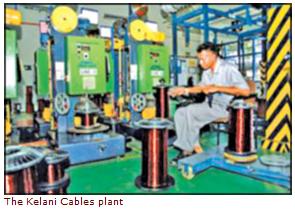
Kelani Cables PLC has recorded a 11 percent increase during the first half of this year compared to the corresponding period in 2009.

The company expects an annual sales target of Rs 3.6 billion for the financial year 2010/2011, Kelani Cables Managing Director Hemantha Perera told Daily News Business.

“We expect to focus more on increasing our export revenue during this year, while targeting on new export markets such as South and Eastern Africa, Mauritius and Seychelles”.

The company participated in the South African International Trade Exhibition 2010 (SAITEX) and Business linkage program held in South Africa.

The collaboration of the High Commission for Sri Lanka in South Africa, Sri Lanka Export Development Board (EDB) organized the participation of Sri Lankan companies for the exhibition.

The participation in this event supported the company to get an idea about the market potential for cables in South Africa.

It also helped to find out interested counterparts to work with Kelani in South Africa. (CdeS)

source - www.dailynews.lk

Market regains healthy momentum

The market momentum picked up through the week’s trading with the ASPI making a sharp gain of 114.5 points at Tuesday’s close and continued its steady upward movement.

The ASPI recorded a week on week gain of 447.21 points or 8.7 percent to close at 5,563. The MPI has regained to close at 5,863 up 118.41 points or 2.06 percent as against last week. Total turnover recorded for the week is Rs 11.88 billion recording a 27.19 percent increase from last week’s value of Rs 9.34 billion, however on a lesser volume of shares, indicating a shift in investor interest to high value stocks led by Ceylon Investments, Aitken Spence, Carsons and Bukit.

Trading volumes have declined to 279 million, a 10.5 percent drop from 311.8 million shares traded last week. Contributors to market turnover this week were the Banking and Finance sector contributing 17.9 percent, Investment Trusts amounting to 17.33 percent and the Diversified sector contributing 16.85 percent of the total turnover for the week.

Banking sector index gained 491.47 points week on week with DFCC contributing Rs 449.5 million trading within a price range of Rs 280.20 to Rs 300.00.

Trading in the investment trust was led by a 10.62 percent stake of Ceylon Investments changing hands from Carsons to Ceylon Guardian Investment Trust increasing the latter’s stake in CINV to 66.89 percent. CINV is the top contributor to Turnover this week amounting to Rs 1.08 billion or 9 percent of total turnover while JKH has contributed 8.45 percent of week’s total turnover value.

SMB Leasing topped the list of heavily traded stocks this week with 29.8 million shares changing hands while Dialog which was the highest last week, traded 28.4 million shares this week to come into second place. Piramal Glass traded 18.2 million shares this week.

Foreign investors continued to be net sellers this week amounting to an outflow of Rs 733.16 million as against a net selling of Rs 596.85 million last week. Foreign purchases amounted to Rs 1.4 billion while foreign selling amounted to Rs 2.1 billion. DIST and DFCC shares accounted for significant foreign selling which was picked by local institutional investors. Foreign trading levels indicate an improvement this week with both buying and selling showing a growth of 48.05 percent and 38.33 percent respectively as against last week’s declines.

Morisons (NV) is the top price gainer for the week gaining 60.21 percent to close at Rs 1241.60. LOLC, Three Acre Farms, Morisons (X) have also recorded significant price gains week on week. Top losers were Merc antile. Shipping losing 14.24 percent and Convenience Foods losing 10.06 percent, followed closely behind by CIT losing 9.47 percent.
Point of view

Overall market activity levels have shown a considerable improvement this week after last week’s subdued status with investors rallying on positive earnings.

We expect this momentum to continue backed by earnings potential and investors reacting positively to the share splits announced by Aitken Spence and Watawala.

The anticipation of further corporate announcements of capital restructuring by similar counters or high value stocks aimed at increasing liquidity in the market will stimulate market activity during the week ahead.

We expect the overall momentum to remain positive during next week’s trading.

source - www.dailynews.lk

More companies likely to enter CSE

Charumini de Silva

There is possibility for 10 to 15 companies to get listed in the Colombo Stock Exchange (CSE) within the next year, an industry expert said.

"Sri Lanka's capital market has been performing well during the post war situation. Therefore, another fifty companies could enter into the capital market in the years to come," he said.

More companies entering into the capital market will provide them a better opportunity to raise capital in a cost effective manner. It also helps the company to have credibility, a valuation and tax benefits.

However, the participation of Small and Medium Entrepreneurs (SME) in the stock exchange is comparatively low.

The Securities and Exchange Commission (SEC) is encouraging more SMEs to get listed in the CSE as there is much scope for this segment to expand their business. When companies are listed in the CSE, it will help to attract more foreign and local investors to capital market activities.

Although market capitalization of the CSE has increased over 10 fold since 2002, our market remains very small in relation to regional markets. One of the reasons for this is that the number of listed companies during this period remaining static, Securities and Exchange Commission Capital Market Development and Research Director Vajira Wijegunawardane told Daily News Business.

However, during the post war scenario we have seen encouraging signs of six companies raising finance by way of IPO's with more being in the pipeline.

"It is important to focus on encouraging large companies to get listed in the CSE as they would raise capital, while making a big impact on increasing the market capitalization of the CSE and add liquidity in the market," he said.

The Director said State owned enterprises too should be encouraged to tap the capital market for fund raising.

For example the Bank of Ceylon raised finance with their listed debenture issues.

Another option which needs to be pursued has been done very successfully is to find fund infrastructure projects through the capital market. This method is being practised in other countries in the region,especially in India to raise part of their infrastructure development funds.

source - www.dailynews.lk

Sunday, August 22, 2010

Exchange gain helps Dilmah owner to clear billion rupee bar

Ceylon Tea Services PLC (CTS), owners of the Dilmah brand of Ceylon Tea, has posted an after-tax profit of Rs.1.2 billion in the year ended March 31, 2010, nearly double the Rs.519.8 million earned the previous year on an improved turnover of Rs.4.9 billion, up 11% from the previous year.

Profits have been boosted by a foreign exchange gain of Rs.544.6 million, up from a loss of Rs.210.1 million on this account the previous year, accounts published in the company’s just released annual report reveals.

Dilmah founder Merrill J. Fernando, who says that he owes his success to the quality of Ceylon tea, has focused in his Chairman’s Review to tea prices going through the roof during the year under review.

He said that while prices remained volatile in the first half, they stabilized later to provide a more favourable environment after two very difficult years.

"It is quite remarkable that tea prices reached highest ever levels, disregarding the fact that Middle Eastern markets, captive to Ceylon tea for generations, are deserting Ceylon tea for aggressively promoted and marketed international brand names which use cheaper tea of a style of manufacture culturally alien to Arab palates," Fernando said in his review.

"Pitiful marketing inactivity on the part of our traders and the Sri Lanka Tea Board left the opportunity open for this effective intrusion into exclusive Ceylon tea markets."

He reported that exports to Saudi Arabia, a prolific consumer of Ceylon tea previously, have slumped to 4.7 million kilos in 2009 from 11.4 million kilos in 2000.

Fernando, always an advocate of "Pure Ceylon Tea," said that the answer to Sri Lanka tea losing its preferred position in Middle Eastern markets is not to follow market leaders with branded tea and CTC manufactured tea but to re-launch traditional grades of pure Ceylon tea and market them strongly.

"There was a very popular pure Ceylon tea, packed and shipped from Sri Lanka under an importer owned brand name, which dominated the Saudi Arabian market for several generations. Sadly for Sri Lanka, that brand name too is now blended with other origin teas and packed in Saudi Arabia," he said.

"The Sri Lanka Tea Board invested several million dollars in advertising and promoting that foreign brand while being made aware that it will, sooner or later, become our biggest competitor in that country."

Fernando estimated that foreign exchange earnings from tea today would have comfortably topped USD 3 billion per year by now if more tea exporters made proper use of government incentives offered in the early 1980s to encourage exporters to move away from bulk tea exports to value added packaged tea under exporter-owned brand names.

He attributes the success of his Dilmah brand to having made optimal use of the incentives offered including bank interest subsidies, grants for tea bagging machines and tax holidays.

"In fact, these incentives helped to establish in our country a unique infrastructure for brand building and manufacture of value added tea – an industry feared by big overseas corporations and much envied by other tea producing nations," he said.

Fernando said that government may not have realized that by providing these incentives without any guidelines and clear directives how they should be used could make them counter productive. Instead of developing Sri Lanka brand names, the incentives were exploited by foreign traders to build their own brand names without their investing in plant and machinery.

"In this process, all the benefits of incentives accrued to foreign companies aided by local exporters. The resulting cost to the tea industry and to the country has been enormous, apart from the immeasurable long term loss created by these very same brand names which are our biggest competitors today," Fernando said.

He said demands that are currently being presented to government by exporters, largely on behalf of these foreign brand owners, are extremely harmful to the image and future of Ceylon tea.

"Many tea exporters are reliant on private label business (and) therefore they are subject to pressures which endanger the future of Ceylon tea," he said.

Ceylon Tea Services applied the incentives granted by the government strictly to benefit our tea industry and our country. The Dilmah brand was a beneficiary of government incentives and had in turn rewarded the industry by advertising and promoting Ceylon tea.

Dilmah helped to create a positive impression of Sri Lanka over the past 22 years by investing USD 8 to 12 million a year specially during the past 12 years, Fernando said.

"If 10 other brand names were developed taking advantage of incentives, Ceylon tea would have again become a powerful force," he said.

The directors of the company were rewarding the shareholders with the highest ever dividend paid by CTS – Rs.30 per share, up from Rs.25 per share the previous year.

Fernando expected the current year to provide greater opportunities to CTS according to present indications. He anticipated higher revenue and said that new activities and new innovations will keep Dilmah ahead of the competition.

Fernando concluded his review with a tribute to the late, Mr. Desmond Fernando, PC, who had been associated with CTS from its inception. He was a pillar of strength to the company and made a valuable contribution to it during his long association with CTS. He was also a close friend.

CTS has a stated capital of Rs.200 million, reserves of Rs.1.9 billion and retained earnings of Rs.3.25 billion in its books with total assets running at over Rs.5.9 billion and liabilities Rs.597.3 million.

M.J.F. Teas (Pvt) Ltd with 65.38% and M.J.F. Exports (Pvt) Ltd with 21.28% are the company’s biggest shareholders.

The CTS share traded at a high of Rs.550 and a low of Rs.300 during the year under review against a trading range of Rs.350 to Rs.255 the previous year.

The directors of the company are: Messrs. Merrill J. Fernando (Chairman), Himendra S. Ranaweera (Deputy Chairman/CEO), Malik J. Fernando, Dilhan C. Fernando, Minette Perera, Roshan Tissaaratchy, Rajan Asirwatham and Gritakumar E. Chitty.

source - www.island.lk
Three redeeming factors in external finances

Three factors are likely to mitigate the adverse impact of the high merchandise trade deficit. These are the high prices of tea and rubber combined with an improved production performance in the two crops. The increasing inflow of worker remittances will offset to a fair extent the merchandise trade deficit and reduce the trade deficit. The increasing numbers of tourists visiting the country are expected to contribute to a significant increase in foreign exchange earnings from tourism

Three factors are redeeming the country’s external finances that may have otherwise reached crisis proportions.

The increasing large import bill, mainly due to higher prices of imports and poor export performance in industrial exports, has caused a very large merchandise trade deficit. This would, in turn, result in a serious dent in the balance of payments.

However, three factors are likely to mitigate the adverse impact of the high merchandise trade deficit. These are the high prices of tea and rubber combined with an improved production performance in the two crops. The increasing inflow of worker remittances will offset to a fair extent the merchandise trade deficit and reduce the trade deficit. The increasing numbers of tourists visiting the country are expected to contribute to a significant increase in foreign exchange earnings from tourism. With these three favourable developments the country could avert a serious balance of payments problem. Foreign borrowing would ease the strain on the foreign reserves but these would at the same time increase the country’s foreign debt and debt service costs.

Trade deficit

In the first five months of this year (January to May 2010) the merchandise trade deficit ballooned to US dollars 2,351 million. This was more than double (117%) what it was during the same period of last year. As this trend is likely to continue, at years end the merchandise trade deficit is likely to reach a massive amount exceeding US$ 5,000. This is similar to the serious trade deficit in 2008 that led to a balance of payments problem in 2009. This serious situation is likely to be averted this year due to the increasing remittances from workers abroad, the boom in tea and rubber exports and the increased earnings from tourism.

Worker remittances

During the first five months of 2010, workers’ remittances increased by 13.3% over that of the analogous period of 2009 to US dollars 1,498 million. This resulted in the trade deficit being brought down from US$ 2,450 to about US$ 1,500 as remittances are a component of the trade balance. If this trend in remittances continues, it means that the overall trade deficit would be brought down from an annual merchandise trade deficit of about US$ 5,000 million to around US$ 3,500 million.
Although the trade deficit is brought down to more manageable proportions, it must be recognised that it is a large one and that the merchandise trade deficit is most unsatisfactory. The beneficial impact of the remittances should not lead to complacency. The adoption of policies to arrest the industrial export decline is vital. This is especially so as the GSP plus withdrawal is likely to further dent the merchandise trade account.
Furthermore, it is observed that the remittances in May were at a lesser rate of increase than in the previous months. In the first four months, remittances grew by 14%. This has dropped somewhat to 13% owing to remittances in May being an increase of only 8.6% over that of May 2009.

Tea and rubber boom

Tea and rubber prices are on an increasing trend. The high prices coupled with increased production, especially of tea, are increasing agricultural export earnings at a time when industrial exports are not faring well. Tea export earnings have increased owing to both a significant increase in prices and an increase in tea production and exports. Indications are that tea production would increase in the second half of the year to reach a record level and international prices would rise still further owing to supply constraints and healthy demand factors.
Tea export earnings grew by as much as 26% in the first five months of this year mainly due to improved international prices. Tea prices increased 13.0% to US dollars 4.44 per kilogramme owing to higher demand from the Middle East. Tea production is expected to reach a record level of over 320 million kilogrammes beating the previous high of 318.7 million kilogrammes in 2008. In the first half of this year (January to June 2010), tea output increased by 27.8% to 166.9 million kilogrammes compared to the first six months of last year when production was low.

Favourable weather, better fertiliser use and an absence of labour unrest were important factors that yielded this increase. If favourable conditions continue into the rest of the year as expected, total tea production for this year is likely to exceed 320 million kilos. With the expectations of good international prices, export earnings from tea are likely to be high owing to poor production conditions in other tea producing countries. However, tea exports increased by less than 6% in May this year compared to the same month last year. The Central Bank attributes this to the strong promotional campaigns by other tea producing countries. However, this setback is not likely to continue.

Rubber prices reached a record US dollars 3.40 per kilogramme, reflecting a year-on-year increase of 125.4 % mainly due to the higher demand for natural rubber from China, India and Malaysia. However, volumes of rubber exports declined by 47.1% in May 2010. According to the Central Bank, this was due to the adverse weather conditions in the major rubber producing areas of the country.

Tourist earnings

The earnings from tourism that began to rise in the latter part of the year after the end of the war have continued. Tourists arrivals increased by 48.4% during the first half (January-June) of 2010, with a total of 278,652 arrivals to the country in comparison to 187,729 arrivals during the same period last year (2009). The increase in tourist arrivals in the first half of 2010 have been mainly from India and other South Asian countries, Western Europe, East Asia, North America, Australasia, Middle East, North America and Eastern Europe.
Tourist earnings last year amounted to US $ 326.3 million. Given the current increasing trend in tourist traffic, it is most likely that this year’s earnings would reach around US$ 700 million making it one of the important contributors to the country’s balance of payments.

Bailed out

The merchandise trade deficit could be even higher than the projected US$ 5000 million owing to several foreseeable unfavourable international developments. The food import bill is likely to rise with an expected increase in prices of especially wheat, owing to the destruction of crops in Russia. Oil prices are likely to remain high and imports of consumer and intermediate goods are likely to increase significantly. The tardy growth in the US economy and only a modest growth of 1% in Europe and the loss of GSP plus concession imply a poor performance for industrial exports. It is possible that the country would be bailed out of the serious merchandise deficit by remittances, agricultural export earnings and tourism.


source & photo credit - www.nation.lk

SL Embassy in US brings popular Americans to Lanka

The Embassy of Sri Lanka in the United States on Friday brought in 25 well known American media personalities into Sri Lanka on a 9-day visit, a measure which it said could give immense publicity to the island- consequently, a boost for the booming Tourism industry.
The set of tourists includes famous film producer, William Bowling (who is a key figure in deciding locations for film shoots) and other popular travel writers on various internet blogs and magazines including Margie Goldsmith, who writes to the website mgproductions.com.

“It is our pleasure to bring this group of American travellers to Sri Lanka, and I look forward to introducing these travellers to our island of unrivalled splendour and our welcoming culture. I know our journey will be an eye-opening experience that will highlight Sri Lanka’s boundless potential,” said Sri Lanka’s Ambassador to the United States, Jaliya Wickramasuriya, who personally accompanied the guests on tour.

The visit is part of a partnership between the Embassy and Sri Lanka Tourism Development Authority, which had launched a programme called ‘Signature Tours’, to promote Sri Lanka as a destination.
“The Embassy plans to arrange Signature Tours on an annual basis,” Wickramasuriya said.
The itinerary of this inaugural venture is organised by ‘Sri Lanka Tailor Made’, an arm of leading travel company, Jetwing Travels Private Ltd.

“The 12-day itinerary includes travel from Colombo to the UN World Heritage Site located in the Galle Fort, followed by visits to the renowned countryside and Tea fields of Nuwara Eliya,” Manager- Jetwing’s Sri Lanka Tailor Made, Sriyantha Sampath told The Bottom Line.

Earlier this year, the New York Times named Sri Lanka its number one Travel Destination in 2010, while The National Geographic ranked the island second among its top 25 places to visit this year. (AR)


source - www.thebottomline.lk

Tourism booms as room strength and hotels grow

By Chanaka de Silva

In the new phase of tourism development where island resorts are being established, another of the 14 islands in the northwest coast of Kalpitiya is being leased out next week. This in addition to one other island leased earlier and both islands from the Kalpitiya islands’ development plan would add 350 rooms to the Sri Lanka’s tourism room strength, a top government official said this week.

“Of the 14 islands we will be developing another six islands in the near future. A key feature in this project is that we have integrated the people of the area and will not be moving them. At present projections these resorts should be ready by 2012,” S. Kalaiselvam, Director-General, Sri Lanka Tourism Development Authority (SLTDA), told the Business Times.

Commenting further on other projects in the pipeline, he said; “Pasekudah will also be developed on the East coast. Where we had only three hotels we have now planned 13 new projects. On completion this will add another 1000 rooms to the pool. Of the investors six parties have already started construction.”
Further new development in the East will include Kuchchaveli where a 500-acre block of land is to be offered for development. It is now in the process of been declared a tourism promotion area. With this done it will possible to monitor all development activities there. The process of actively seeking other properties for development is also underway, he added.

“With the increase in tourism we are looking towards the SMEs for active participation. Here they are encouraged to register ‘home stay’ facilities with the SLTDA. Any unit meeting the requirements may register under this scheme. As a large number of rooms are required now in the North with the festivals and both the tourists and the Diaspora arriving, this is a pressing requirement. As at now 300 parties have registered. Their details are displayed on the SLTDA website and could be booked on line direct,” he said.

Referring to the incentives on offer to the tourism investor, Mr Kalaiselvam said; “The most attractive incentive is land to an investor. Any investor who meets the criteria will be eligible for this. In addition various duty free concessions and tax holidays are also available. The biggest incentive for the industry is the tourist and with the end of the war we have been able to attract them here in numbers.”

He expects tourism numbers to exceed 600,000 this year. “We have already passed the 340,000 mark in the first seven months of this year. The industry is so busy now that when we call a meeting with the guides no one attends as they are all on tour.”

source - www.sundaytimes.lk

Sri Lanka stock price band seen curbing abuse, preventing bubble

Aug 22, 2010 (LBO) - A daily 10 percent price band imposed on Sri Lanka's tiny stock market should be continued as it helps curb rampant abuse by a few investors with deep pockets and prevent a bubble, news reports said.

"Some investors urge continuation of price curbs", the privately-owned Sunday Times headlined a report on the market.

Even as the market regulator, Securities and Exchange Commission (SEC), prepares to lift the controversial price curbs on share trades, some local investors are praising the restrictions and urging the SEC to continue them, it said.

“This is a very, very good move and long overdue,” the newspaper quoted K Viknarajah, a veteran investor and long-time campaigner for good governance and ethics in the market, as saying.

“I have been advocating for a long time some measures to control casino-type trading in a market where there is large-scale insider trading..”

The SEC imposed the price band after months of speculative trading that saw some shares rise sharply in value despite no change in their fundamentals.

The price band has been criticised by some investors and analysts and praised by others.

Sri Lanka's stock market has been hitting record highs in recent months, being Asia's second-best performing bourse, prompting concern of an unsustainable bubble developing.

Sri Lankan stocks have risen over 50 percent so far this year, while last year it skyrocketed 125 percent.

The state-owned Sunday Observer quoted capital market analysts as saying share prices shot up to unprecedented levels owing to "either manipulation or unnecessary speculation."

The newspaper said the price band had helped foil a "capital market bubble" developing.

It quoted the Director of the SEC's Financial Service Academy, Dissa Bandara, as saying the price curbs were criticised owing to lack of awareness among stock brokers and investors.

“The price caps imposed by the SEC on share prices have served the purpose and market participants will understand that unnecessary anticipation has no value,” he said.

Bandara said the intervention by the SEC was timely as it helped avert a "major catastrophe in the capital market which would have led to an economic crisis."

Viknarajah told the Sunday Times that the price band should continue until such time regulation controls sharp shifts in prices.

He said the market shouldn’t get too alarmed about these regulatory processes because price curbs are in force at least in 10 to 15 countries including Pakistan in the region.

Insider trading is a huge problem, the newspaper quoted Viknarajah as saying.

He noted that company directors, auditors and some other influential stakeholders have access to inside information and some of them – not all - trade through related parties, a new way to circumvent the rules.

“Small, innocent shareholders don’t have such access and there’s no level playing field. Insider trading has been going on for a long time,” he said.

Surekha Sellahewa, chief executive of the Colombo Stock Exchange, said last week that price manipulation was rife in the market.

"This (Colombo Stock Exchange) is an illiquid market and there is a lot of manipulation," she told a seminar on investing in stocks.

Viknarajah, referring to concerns that investors have burnt their fingers over the sudden price bands, said even with a 10 percent restriction, investors can make good money.

“Bank interest brings you less than 10 percent per annum," he told the newspaper. "Here an investor could make three to four times that and if, for example, a stock rises by 10 percent per day for 10 days, that’s a 100 percent increase or more in price. Greed should not take over the markets.”

source - www.lbo.lk

Sri Lankan chicks going to Nepal

Fortune G-P Farms (Lanka) Ltd. (FGPF), an associate company of Bairaha Farms PLC, a pioneer chicken producer in Sri Lanka, has exported US$ 22,000 worth of breeding chicks to Nepal this year, said the company in a press release.

FGPF says it will supply another order for US$ 17,100 worth of chicks, to Nepal, in early September this year. Last year, the company exported two consignments of parent broiler breeder chicks to Nepal. FGPF is the largest and most modern of the two grandparent farms and hatchery operations in Sri Lanka, said the company. Local customers among others, include the Bairaha Group, Midland Breeders, Nelna Farms and the National Livestock Development Board.

“FGPF is well equipped to export quality parent broiler breeder chicks, which is a creditable achievement in a situation where some Sri Lankan companies still import their requirements of parent broiler breeder chicks,” said the company.

FGPF says its focus on providing quality products coupled with its ability to meet stringent deadlines, has confirmed its reputation among poultry breeding companies in Nepal. Bairaha Farms and its subsidiary companies are engaged in integrated poultry production including processing chicken, value added production of meat and production of broiler day-old-chicks. Bairaha is a pioneer, large scale, Halal chicken processor in the country.

source - www.sundaytimes.lk

Sunday Business News Articles

SUNDAY OBSERVER

SUNDAY TIMES

THE NATION

SUNDAY LEADER

LAKBIMA NEWS